Nerede, Kimde: -da, -de, -ta, -te
After this lesson you will be able to answer "Nerede?" with the right suffix: masada, sepette, ağaçta.
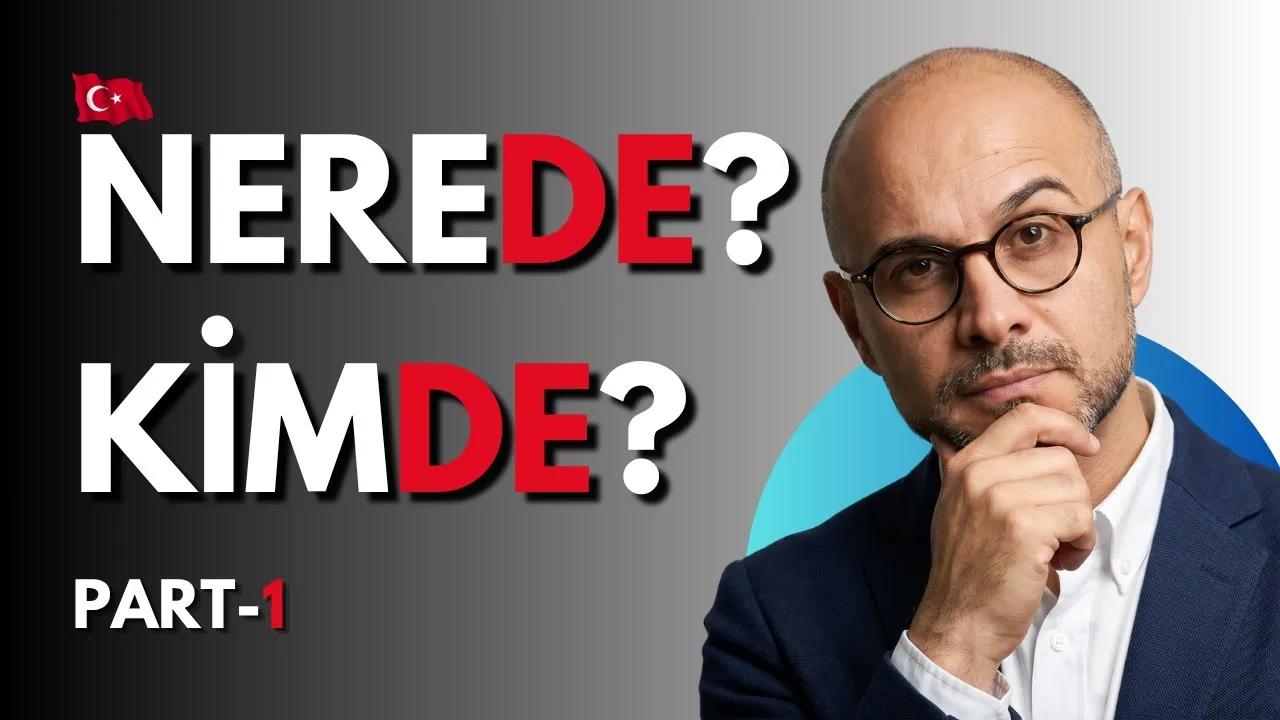
Watch on YouTube · 5:41 (opens in a new tab) Subscribe to the channel (opens in a new tab) Watching the video on YouTube supports the channel.
The rule: two questions, one suffix
Two questions decide which form the suffix takes. Look first at the last letter of the word, then at its last vowel.
| Last letter | Last vowel a, ı, o, u | Last vowel e, i, ö, ü |
|---|---|---|
| Any other letterD group | -da · masada | -de · hastanede |
| f, s, t, k, ç, ş, h, pT group · "Fıstıkçı Şahap" | -ta · ağaçta | -te · sepette |
Examples from the video
- Bardak nerede? Bardak masada. ends in a · D group
- Yumurta nerede? Yumurta sepette. ends in t · T group · last vowel e
- Doktor nerede? Doktor hastanede. ends in e · D group
- Kedi nerede? Kedi ağaçta. ends in ç · T group · last vowel a
Words
| Word | Nerede? | English | Русский |
|---|---|---|---|
| masa | masada | table | стол |
| sepet | sepette | basket | корзина |
| hastane | hastanede | hospital | больница |
| ağaç | ağaçta | tree | дерево |
| sınıf | sınıfta | classroom | класс |
About this lesson
The lesson opens with a scene in the style of the series Magnificent Century: Hürrem Sultan nerede? Sarayda mı yoksa odada mı? Every question in it asks where someone is, and Dr. Furkan Kurt uses it to introduce the two questions this ending answers: Nerede? (where?) and Kimde? (who has it?). After a noun Turkish adds one of four forms, -da, -de, -ta or -te, and the choice is made in two steps.
First look at the last vowel of the word: after a, ı, o or u the ending has a, after e, i, ö or ü it has e. Then look at the last letter: if it is one of f, s, t, k, ç, ş, h or p, the d becomes t. Turkish teachers remember those eight letters with the phrase Fıstıkçı Şahap.
The lesson then checks each example aloud with the two steps: Bardak masada, Yumurta sepette, Doktor hastanede, Kedi ağaçta. Sınıfta and okulda sit side by side so you can see one word take -ta and the other -da. The last examples answer Kimde?: Kalem öğretmende, Telefon Sevinç'te, where a name keeps its apostrophe before the ending. Part 2 practises the same rule in a dialogue from the series.
This lesson is part of the guide: Turkish grammar for beginners
Test yourself
5 questions
Defter masa___.
Answer:-da. masa ends in a, no hard consonant: -da.
Ali park___.
Answer:-ta. park ends in k (Fıstıkçı Şahap), last vowel a: -ta.
Annem ev___.
Answer:-de. ev ends in v, last vowel e: -de.
Çocuklar bahçe___.
Answer:-de. bahçe ends in e: -de.
Kitaplar dolap___.
Answer:-ta. dolap ends in p, last vowel a: -ta.